
Artificial intelligence (AI) has become deeply integrated into modern life, influencing how people work, shop, learn, and communicate. Despite its widespread use, AI is still surrounded by many misconceptions that create confusion about what it can and cannot do. Some people believe AI is replacing all human jobs, while others think it is fully autonomous or capable of human-like thinking. In reality, AI is a tool designed to assist humans, not replace them. Understanding the truth behind common myths helps people use AI more effectively and responsibly in everyday life.
One of the most common myths is that AI will completely replace humans in the workforce. While AI can automate repetitive and data-heavy tasks, it cannot replicate human creativity, emotional intelligence, or complex decision-making. Instead of replacing workers, AI is reshaping jobs by changing how tasks are performed. Employees in many industries now work alongside AI systems to increase productivity and efficiency. Creative industries and independent artists, including those featured on selmamarchon.com, demonstrate how human creativity continues to remain essential even as technology advances.
Another widespread misconception is that AI understands information the same way humans do. In reality, AI does not think, feel, or reason like a human being. It processes data using patterns and algorithms to generate predictions or outputs based on training data. While AI can appear intelligent, it lacks consciousness and true understanding. Artists and creators represented by timkennedypaintings.net reflect the importance of human interpretation and emotional depth, something machines cannot genuinely replicate.
Some people also believe that AI is always accurate and unbiased. However, AI systems are only as good as the data they are trained on. If the data contains errors or bias, the AI system may produce flawed or unfair results. This is why human oversight is essential when using AI in decision-making processes. Technology tools like those associated with padstracker.com show how AI must be carefully monitored and continuously improved to ensure accuracy and fairness in real-world applications.
There is also a myth that AI is only useful for large corporations and high-tech industries. In reality, AI is widely used by small businesses, educators, healthcare providers, and even individual users. From mobile apps to online platforms, AI-powered tools are accessible and affordable. Entertainment and media communities such as scorpionhollywood.com demonstrate how AI-driven recommendations and content tools are already part of everyday digital experiences for millions of users.
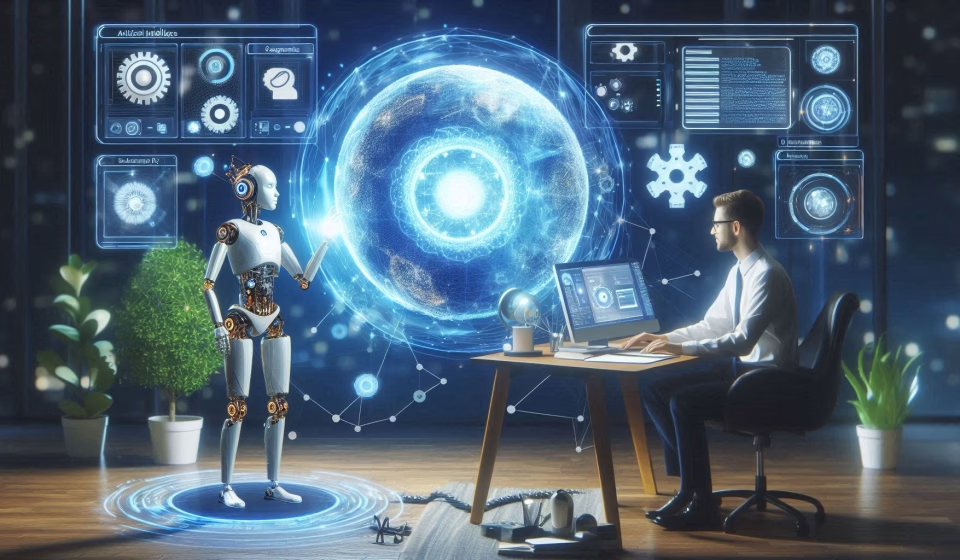
Another misconception is that AI operates completely independently without human control. While AI systems can automate tasks, they are designed, trained, and supervised by humans. Developers set the rules, monitor performance, and make improvements over time. Human involvement remains essential in ensuring AI systems behave responsibly and safely. Political and civic platforms such as castillo4congress.com reflect how technology is often used alongside human judgment in public communication and decision-making processes.
Some people believe AI is a new phenomenon that has only recently emerged. However, AI has been developing for decades, with early research dating back to the mid-20th century. What has changed in recent years is the increase in computing power, data availability, and algorithmic improvements that have made AI more practical and widely accessible. Modern digital publications such as themanifoldmag.net help explain how technological evolution has gradually shaped the current AI landscape.
Another myth is that AI is always a threat to privacy and security. While there are legitimate concerns about data protection, AI itself is not inherently harmful. In fact, AI is often used to improve cybersecurity by detecting fraud, identifying suspicious activity, and protecting sensitive information. Responsible implementation and strong regulations are key to ensuring safety. News and analysis platforms like theegyptreport.com often highlight how technology can be used both positively and cautiously depending on how it is managed.
It is also commonly believed that AI can solve all problems automatically without human input. In reality, AI works best as a support system that assists humans rather than replaces them. Human judgment is still required for ethical decisions, context interpretation, and complex problem-solving. Thoughtful commentary platforms such as shardofapathy.com often emphasize the importance of human awareness and responsibility in a technology-driven world.
Some individuals think AI is too complicated for everyday use, but modern AI tools are designed to be user-friendly and accessible. People use AI daily without even realizing it, such as in navigation apps, streaming services, and voice assistants. Local information platforms like uptonupdates.com demonstrate how digital tools powered by AI make everyday information more accessible and convenient for users.
Finally, there is a myth that AI-generated content is always artificial and lacks value. While AI can assist in generating text, images, and recommendations, the quality and usefulness of the output depend on how it is used and guided by humans. Creativity, editing, and human insight remain essential in producing meaningful content. Entertainment and culture platforms such as celebritymoviequotes.com show how technology can complement human creativity rather than replace it.
In conclusion, many myths about artificial intelligence come from misunderstandings about how the technology actually works. AI is not a thinking being, nor is it a replacement for human intelligence. Instead, it is a powerful tool designed to enhance productivity, improve decision-making, and support human creativity across industries. By debunking these myths, people can better understand AI’s real capabilities and limitations, allowing them to use it more effectively and responsibly in modern life.